
Projects
Loblolly can help you solve complex issues by providing incisive analysis of the root problems, detailed requirements and documentation, use cases, clear options with ramifications for each option, and the information needed to get buy-in for the solutions internally.
Process and Methodology
No matter the size of your project — small discrete projects, iterations that build towards a long-term goal, or large ground-breaking projects — we can help.
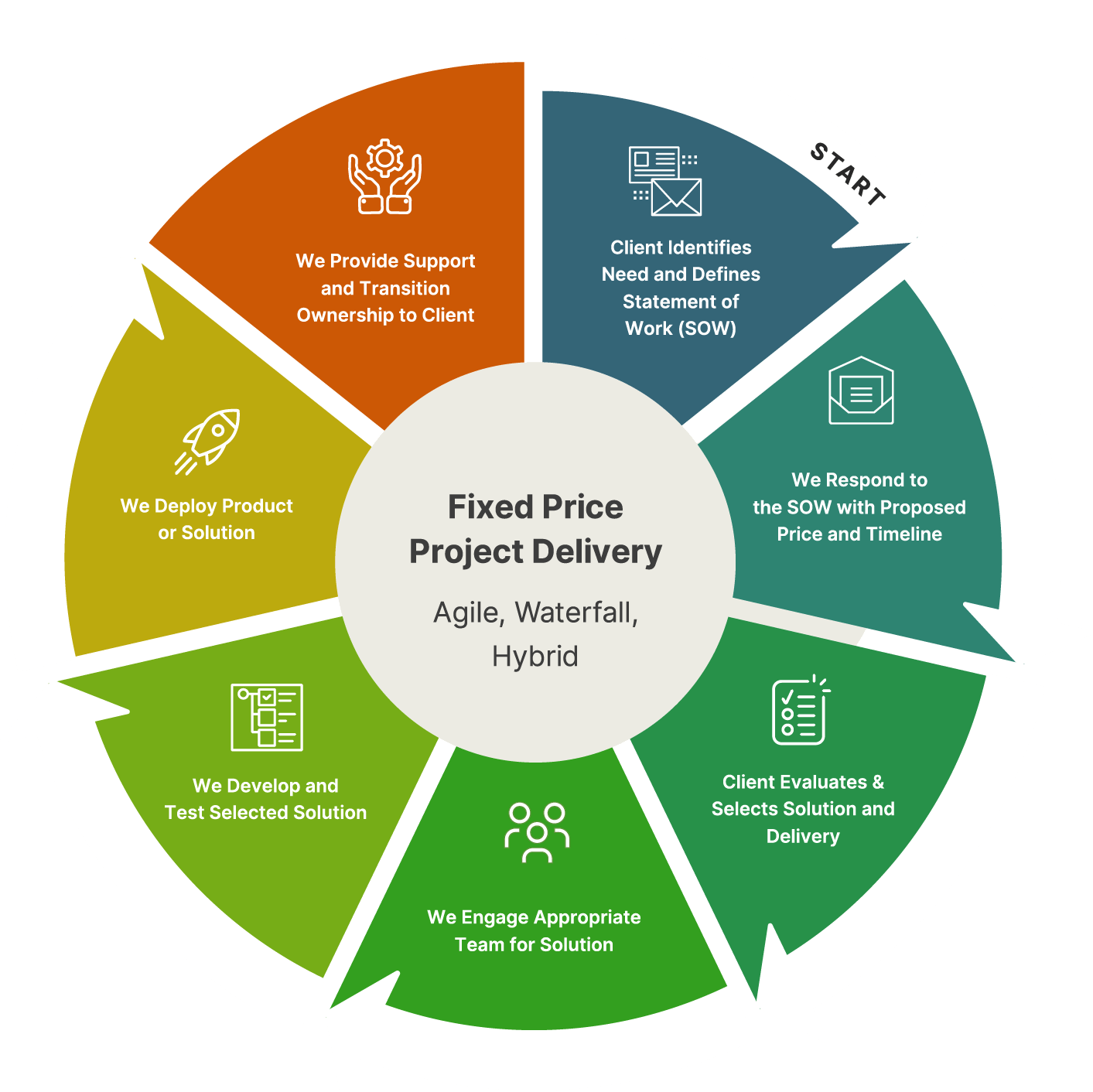
Project-based delivery engagement services allow you to leverage our proprietary Loblolly delivery methodologies and develop a custom team specific to your needs. Our teams are self-managed and built to deliver results.
Example Project Types
Application Development is the development of new applications which may be mainframe, server, network-based, web-based or a combination and may require interfaces to existing applications.
- Troubleshooting
- Modifying
- Maintaining
- Improving security
- Enhancing legacy systems and applications which may be running in a production environment.
ERP is an amalgamation of an organization’s information systems designed to automate and integrate a variety of functions, commonly referred to as “back office,” including financials, human resources and asset management. These systems are usually modularized and generally highly configurable.
- Business Process Reengineering (BPR)
- System or application changes
- Implementation
- Conversion services
- Training
Data governance includes planning, implementation, and business analytics and reporting (BAR) to ensure compliance with regulations and organizational processes.
- IT effectiveness, maturity, governance, and architecture
- Strategic planning activities may include mission statement development, visioning and goals, objectives, and strategy development
- Assessment of staff knowledge, skills and abilities, bandwidth, time and motion studies, and succession planning
- Organization change management, enterprise architecture, cloud assessments, and network performance assessments
Accomplished by converting/migrating legacy applications to new technology, either with or without new business functionality, or introducing new technology into the enterprise and managing any changes as a result of the introduction.
Transformation may include assessments of the current application portfolio, evaluation of the technology assets before beginning technology transformation and Business Case development for justification of an initiative.
Part of the transformation journey may include planning, analysis, requirements development, proof of concept, deployment, implementation, integration, remediation, data migration, documentation, application programming and support services, and training support.
A transformation initiative may also include return on investment (ROI), benchmarks, and milestones.
Additional areas include the following:
- Website content accessibility compliance
- Cloud transformation
- Digital transformation
- IT organizational transformation
- User acceptance testing
Business Intelligence (BI) enables an organization to perform in-depth analysis and includes data mining of detailed business data providing real and significant information to business users. BI may include an integrated group of operational and decision support applications and databases. BI makes use of tools designed to easily access data warehouse data.
Loblolly specializes in modern analytics. Our consultants can help your organization develop strategy, plan, and execute implementation to turn data investments into valuable business information.
A data warehouse collects, organizes and makes data available for the purpose of analysis and gives organizations the ability to access and analyze information about its business. The function of the data warehouse is to consolidate and reconcile information from across disparate business units and IT systems and provide a context for reporting and analysis.
Defining the road map for a data warehouse initiative may include assessment of technology and infrastructure, as-is documentation, business requirements gathering, use case development, and reporting requirements analysis.
Common initiatives include the following:
- Defining data warehouse architectural design
- Data warehouse processes and sourcing
- Extraction, transformation, analytics, and loading of data sources
- Planning, assessment, product installation and tuning
- Prototype development, deployment, data cleansing, data mart development and support
- Data migration, integration with data mining
- Integration with business intelligence tools, artificial intelligence, and/or systems
- Data scrubbing
- Data transformation
- Training and knowledge transfer
Independent verification and validation procedures are used for in-depth analysis of a product, service, or system for compliance with requirements as well as the independent oversight of software (or systems) development life cycle (SDLC) processes and specifications.
Research and advisory services include requirements gathering, facilitation activities, scoring criteria development, evaluation criteria development, negotiation guidance and assistance, and contract transition assistance.
Examples:
- Cost optimization including software license cost analysis
- Financial planning and pricing structures
- Market reviews/market research
- Market engagement
- Transition/implementation assistance
- IT contract management assistance
Project and Program management services include any or all of the project management processes identified by the Project Management Institute (PMI) as published in the most recent edition of the PMBOK® Guide, including practice guides such as Agile and Managing Change in Organizations.
Loblolly can manage projects using any of the following approaches:
- Customer’s tools and processes
- Commercially available off-the-shelf tools
- Contract Holder’s own proprietary tools and processes to manage a project
- Texas Project Delivery Framework
Example projects:
- Business case development
- Statewide impact analysis
- Cost to benefit analysis
- Risk assessment
- Stakeholder management
- Organizational change management
- Strategic planning
- Program assessment
- Agile development, training, coaching
Need help with Staffing?
Loblolly also offers a staffing model if that works better for your organization.